AI dunning that recovers failed payments on autopilot
- 12.4%More failed payments recovered
- 22%Average reduction in processing fees
- 2.5BAnnual orchestrated volume
- 140+Currencies supported
Revenue lift calculator
How much revenue are declines costing you?
Pick your industry and enter your monthly revenue to see what smarter routing and recovery could add back.
Pre-filled with your industry average. Change it if you know yours.
Lost to declined payments today: $55,556 a month
PaymentKit could win back
$20,000a month
That's $240,000 a year
Authorization rate: 90% to 93.6%
Assumes 4% more approved revenue, typical for B2B SaaS. Estimate only; your results depend on your processors, card mix, and regions.
The problem
Most churn starts as a failed payment, not a cancellation
Industry analyses put failed transactions at 5% to 15% of recurring revenue each month before any recovery. At $200K MRR, 10% is $20,000 of charges failing every month, most of it from customers who have no idea anything went wrong.
The bulk of those declines are mundane: insufficient funds the day before payday, a reissued card, a bank being cautious with an online charge. Retry them on a fixed timer and you burn attempts when they can’t succeed, while the card networks count every one.
How AI dunning works
Retries, routing and recovery emails as one flow
Reads the decline code.
An insufficient-funds decline waits for a smarter moment. A do-not-honor tries a different processor. A stolen card or closed account stops right away, so you never re-push a charge the issuer had good reason to block.
Times retries to the billing cycle.
A monthly subscriber three days into their cycle and an annual subscriber at renewal get different plans. Each attempt is placed where it’s most likely to succeed, aiming to recover the payment before the next renewal comes due.
Retries across your processors.
A rebill that fails on one processor can be retried on another in your route: same card, no customer involvement. A single processor’s bad day never becomes a canceled subscription.
Brings the customer in only when needed.
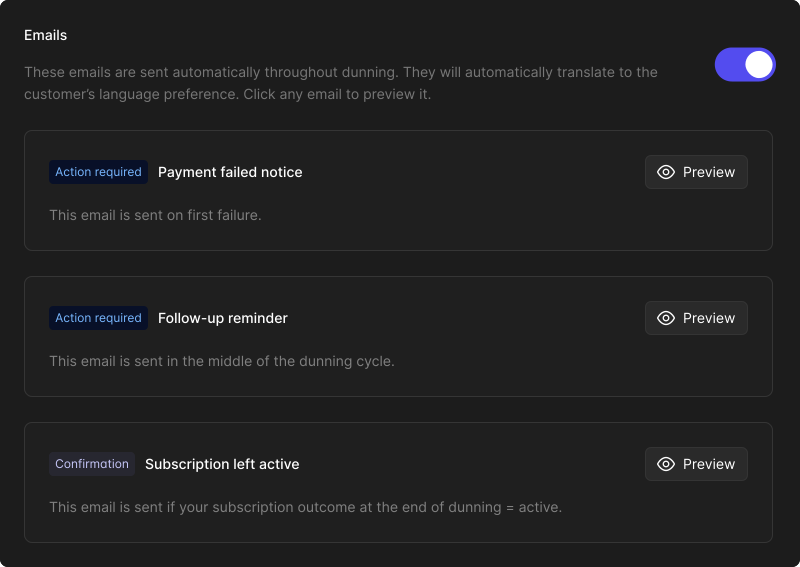
When only the customer can fix it, brand-matched recovery emails go out between retry attempts, with a secure portal to update the card. The moment they do, the next attempt picks up the new credentials automatically.
Prevents failures before they happen.
Network tokens keep stored cards current when they’re reissued or expire, so many renewals approve on the first attempt instead of entering the retry funnel at all.
Ends the way your business does.
When retries run out, cancel the subscription or keep serving the customer and mark the invoice uncollectible. Both outcomes are settings, not hard-coded rules.
Protecting your gateway
Recover more with fewer attempts
Card networks cap and monitor reattempts on the same card, and high retry-failure volume is one of the signals that gets merchant accounts reviewed. Because every attempt is placed where approval is plausible, adaptive retries need fewer of them: your recovery rate goes up while the reattempt count the networks watch goes down.
What you see
Recovered revenue next to the churn it prevents
Recovered revenue and recovery rate live in a dunning performance tab inside Revenue Metrics, beside churn cohorts and net revenue retention. When failures cluster on one processor, PSP benchmarking makes it obvious, and because PaymentKit routes across processors, it’s also fixable.
Want the full detail on retry timing, final-failure handling and gateway risk?
Proof
We run 20+ subscription brands of our own on PaymentKit, with retries and routing across multiple processors.
- 12.4%average lift in failed-payment recovery.
Who this is for
Subscription businesses losing customers who never meant to leave
SaaS, AI apps, memberships, digital products and high-risk subscriptions: anyone billing cards on file every cycle. Especially teams whose dunning today is a fixed retry timer and a generic email, and teams on one processor whose declines have nowhere else to go.
Talk to our team
Tell us about your business
Leave your details and a real person will follow up with next steps. No pitch deck, just straight answers.