Stop renting your payment stack. PaymentKit runs the same billing engine with multi-processor routing, full data ownership, and a 0.65% platform fee on top of the processor rates you already control, not 5% + $0.50 on every sale.
PADDLE ALTERNATIVE
Bring your own processors · Keep your data · No lock-in
22%
Average reduction in processing fees
Average lift in failed-payment recovery
12.4%
Annual orchestrated volume
2.5B
Currencies supported
140+
THE PROBLEM
Paddle’s merchant-of-record model is a great on-ramp. The friction shows up once you’re growing and want control over your costs, your data, and your payment stack.
Paddle runs payments through its own acquiring setup. You can’t bring a negotiated Stripe rate or add a backup processor, so if Paddle’s processing has a bad day, you have no fallback.
5% + $0.50 per transaction is easy to accept at $5K MRR. At $100KMRR it’s about $6,000 every month, and unlike a processor rate, it rarely comes down until you’re very large.
Because Paddle is the seller of record, your customer, card, and subscription data sits inside Paddle’s account. Teams regularly report it doesn’t export cleanly when they try to leave.
Migrations off Paddle are often measured in months. Subscription history, tax records, and saved payment methods don’t move on their own, so the cost of leaving climbs the longer you stay.
Paddle’s MoR model: what it costs you in fees and control
As merchant of record, Paddle is legally the seller. Its name appears on your customers statements, it owns the payment relationship, and it folds global tax compliance into that 5%fee. That’s genuinely valuable when you’re small and selling into dozens of countries. The cost arrives later: an effective rate that often clears 6% once currency conversion is added, no say over which processor runs your money, and data that’s hard to take with you.
A product-by-product comparison, including the places where Paddle’s model still wins.
PADDLE ALTERNATIVE
Billing
Paddle
Full subscription lifecycle support
Trials, coupons, pauses, and mid-cycle plan changes.
Paddle
Usage-based & hybrid pricing
Flat, tiered, and metered models in a single billing flow.
Paddle
Developer test clocks
Fast-forward time to simulate complex billing cycles instantly.
Paddle
Checkout and customer portals
Hosted pages for payments and account management.
Paddle
Your brand as seller of record
Your name on customer statements, invoices, and receipts.
Paddle
Flexible pricing structures and automated subscriber life cycles, independent of your payment processors.
Payment Orchestration
Paddle
Full subscription lifecycle support
Route traffic to optimal PSPs based on cost and approval rates.
Paddle
Bring your own processors
Keep Stripe, Adyen, PayPal, and your negotiated rates.
Paddle
Agnostic vaulting
Total data portability; never be locked in to a PSP again.
Paddle
Zero-downtime failover
Retry declines on a second processor automatically.
Paddle
Fraud controls and SCA
3DS optimization and custom fraud rules to minimize risk.
Paddle
Intelligent multi-channel dunning
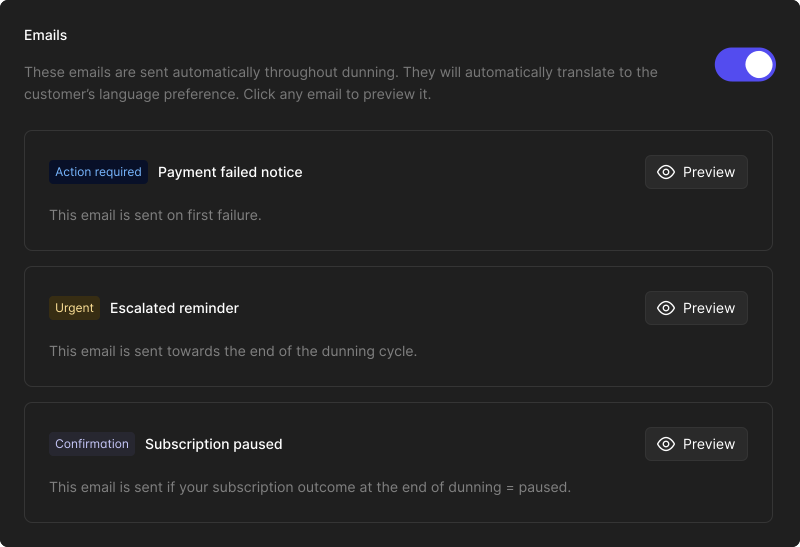
Adaptive retry logic, recovery emails, and more.
Paddle
Route, retry, and optimize payments across every PSP from a single, unified integration.
Revenue Metrics
Paddle
Unified SaaS metrics
MRR, churn, LTV, and NRR across all PSPs and currencies.
Paddle
PSP performance benchmarking
Compare processor success rates to tune your routing.
Paddle
Trial conversion cohorts
Conversion rates grouped by sign-up date and trial length.
Paddle
Advanced segmentation & export
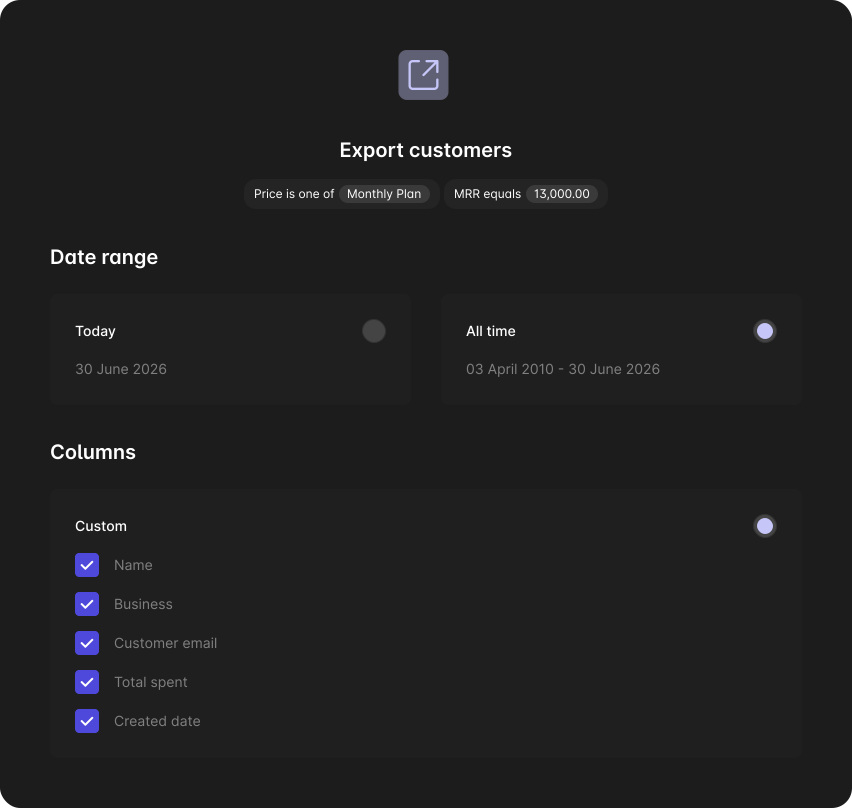
Slice revenue data by any variable and export anytime.
Paddle
Real-time anomaly alerting
Instant notifications when metrics deviate from the norm.
Paddle
A single source of truth for your revenue data, unified across every payment processor.
Paddle’s merchant-of-record model still wins on bundled global tax compliance and charge back liability, it carries both for you inside its 5% + $0.50 fee. See the honest three-way comparison below.
BEYOND PADDLE
Connect Stripe, Adyen, Authorize.net, and PayPal, send each charge to the processor most likely to approve it, and fail over automatically if one goes down.
Recover failed payments with smart retries,re-attempt soft declines on a second processor, and keep one set of fraud rules across all of them.
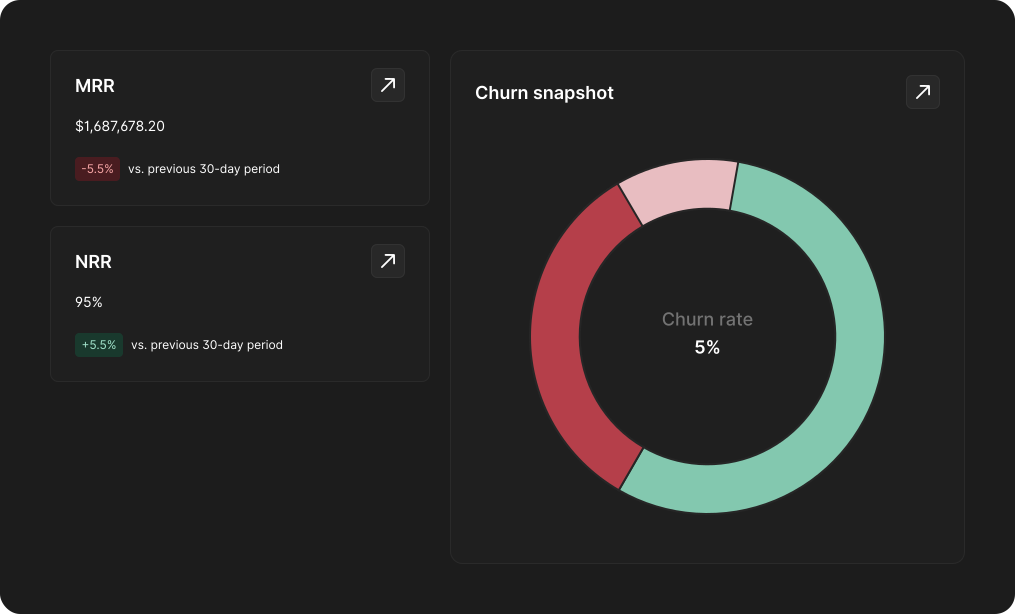
Track MRR, churn, cohorts, and recovered revenue in real time, benchmark your processors against each other, and export the data whenever you need it.
Top 4 reasons
1
Better approval rates and performance optimization
Paddle routes every charge through its own single acquiring setup. PaymentKit offers multi-processor support.
Enhanced payment infrastructure flexibility means more opportunities to boost revenue and scale.
2
Real-time, full data access via a centralized dashboard
Get a big-picture and in-depth view of your metrics and data insights.
Dive into robust reporting and data-driven insights for an accurate assessment of your business health and trajectory against industry benchmarks.
3
Personalized and proactive recovery and retention strategy
Deliver a friction less resolution for failed payments to reduce churn rates.
Go beyond reactive damage control and maximize every customer interaction.
4
Unrestricted data access and control
As merchant of record, Paddle owns your customer and card data. PaymentKit guarantees full access, always.
No surprise data lock-ins and restrictions. Full access to your business data at all times, no ifs or buts about it.
Most teams are live within days. Because you keep your own processors, there’s no waiting on a new acquiring relationship.
MIGRATION
Set up your workspace, checkout, and customer portal under your own brand instead of a third party’s.
01
02
Recreate or import your plans and prices. Flat,tiered, hybrid, and usage-based are all supported.
Link the processors you already use, then set your routing and fail over rules.
03
Verify end to end with a sandbox and test clocks,then move your live traffic over.
04
Paddle bundles everything into one percentage. PaymentKit charges a small platform fee on top of the processor rate you already control,which pulls ahead as you scale.
PRICING
PADDLE
5% + $0.50
/ transaction
All-inclusive merchant-of-record fee.
0.65% + $99
Platform fee on top of your own processor rate.
/ mo
Monthly revenue
Paddle
PaymentKit + Stripe
You keep
$10,000
Paddle
~$600
~$515
~$85/mo
You keep
PaymentKit + Stripe
$50,000
Paddle
~$3,000
~$2,175
~$825/mo
You keep
PaymentKit + Stripe
Monthly revenue
$100,000
Paddle
~$6,000
~$4,250
~$1,750/mo
You keep
PaymentKit + Stripe
Monthly revenue
$250,000
Paddle
~$15,000
~$10,475
~$4,525/mo
You keep
PaymentKit + Stripe
Monthly revenue
Illustrative, assuming a ~$50 average transaction and standard Stripe pricing (2.9% + $0.30). PaymentKit figures include the processor fee plus 0.65% + $99/mo; they exclude tax compliance, which Paddle bundle sand PaymentKit leaves in your control. Your real numbers depend on your processor rates, transaction size,and where you sell.
There’s no single winner. It comes down to how much control you want and who handles your tax.
HONEST COMPARISON
You’re early or selling into many countries and happy to pay around 5–6% for merchant-of-record coverage so you never touch a VAT return.
You sell mostly in one country, want the cheapest processing, and have engineers to build billing and handle tax yourselves.
You’ve outgrown Paddle’s fees, want to own your data and processor relationships,and need routing plus billing in one place.
Choose Paddle
Choose Stripe
Choose PaymentKit
FAQ
"Platform lock-in was our biggest risk. PaymentKit’s independent vaulting gave us total portability over our subscription data. We migrated seamlessly and boosted checkout conversion by 5%."
Marcus Thorne
Head of Engineering @ TweetDeleter