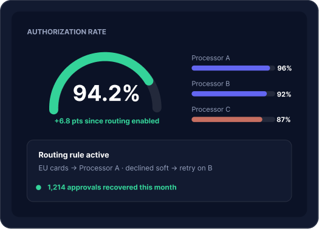
A few percentage points of authorization rate is the cheapest revenue you’ll ever find — it’s money customers already tried to give you. PaymentKit raises the number with smart routing,configurable fraud rules, adaptive retries, and network tokenization, then shows you the lift per processor so you know it’s working.
Authorization Optimization

Route by card type · Benchmark every PSP · Recover soft declines
The stakes
A decline isn’t neutral. For a one-time purchase it’s a lost sale; for a subscription it’s the first step toward involuntary churn, and the customer usually never finds out it happened. At 100,000 transactions a month, the difference between an 88% and a 93% authorization rate is five thousand payments —every month, forever.
Subscription lifecycle Every declined payment is lost revenue – not just a failed transaction
Ask a finance team for the blended rate and someone can usually find it. Ask for the rate on European debit cards through their secondary processor and the room goes quiet. Without per-processor, per-segment numbers, you can’t tell whether a dip is your fraud rules, your processor, or just seasonality.
Most businesses don’t know their true authorization rate by PSP
Once you’ve cleaned up your fraud rules and your retry logic, a single processor gives you nothing left to pull. Its issuer relationships, its regional coverage, and its risk appetite set your ceiling. The only way past it is a second processor and somewhere intelligent to route between them.
A single-processor setup has a ceiling you can’t optimize past
Diagnosis
Three culprits show up in almost every account we look at.
No processor is best at everything. One is strong on US credit, weak on European debit; another is the reverse. Forcing every transaction down one pipe means accepting that processor’s worst segments along with its best.
False declines are quiet. The rule blocks the charge, no fraud occurs, and the dashboard looks safe — while a paying customer bounces off checkout. Studies keep finding merchants lose more to false declines than to the fraud the rules were written for.
When performance data lives in each processor’s own dashboard, in each processor’s own format, nobody compares them. Underperformance goes unnoticed for quarters because there’s no side-by-side view that would make it obvious in a minute.
Four levers, one platform
Every transaction goes to the processor with the best approval record for that card type, currency, and region — and soft declines get a second chance on a different processor instead of a dead end. Routing rules are yours to set; the defaults learn from your own traffic.
One set of fraud rules that applies consistently across every processor, tuned by you. Tighten screening on segments where fraud actually happens, relax it where it doesn’t, and stop paying for safety you don’t need with false declines.
Declines that can be saved, get saved. Retry timing adapts to the failure code and the billing cycle, so an insufficient-funds decline waits for a smarter moment while a do-not-honor tries a different route entirely.
Network tokens replace raw card numbers with credentials the card networks keep current. When a customer’s card is reissued or expires,the token updates behind the scenes — the renewal goes through and nobody has to type in a new number.
Visibility
Optimization without measurement is guesswork. These three views live in Revenue Metrics.
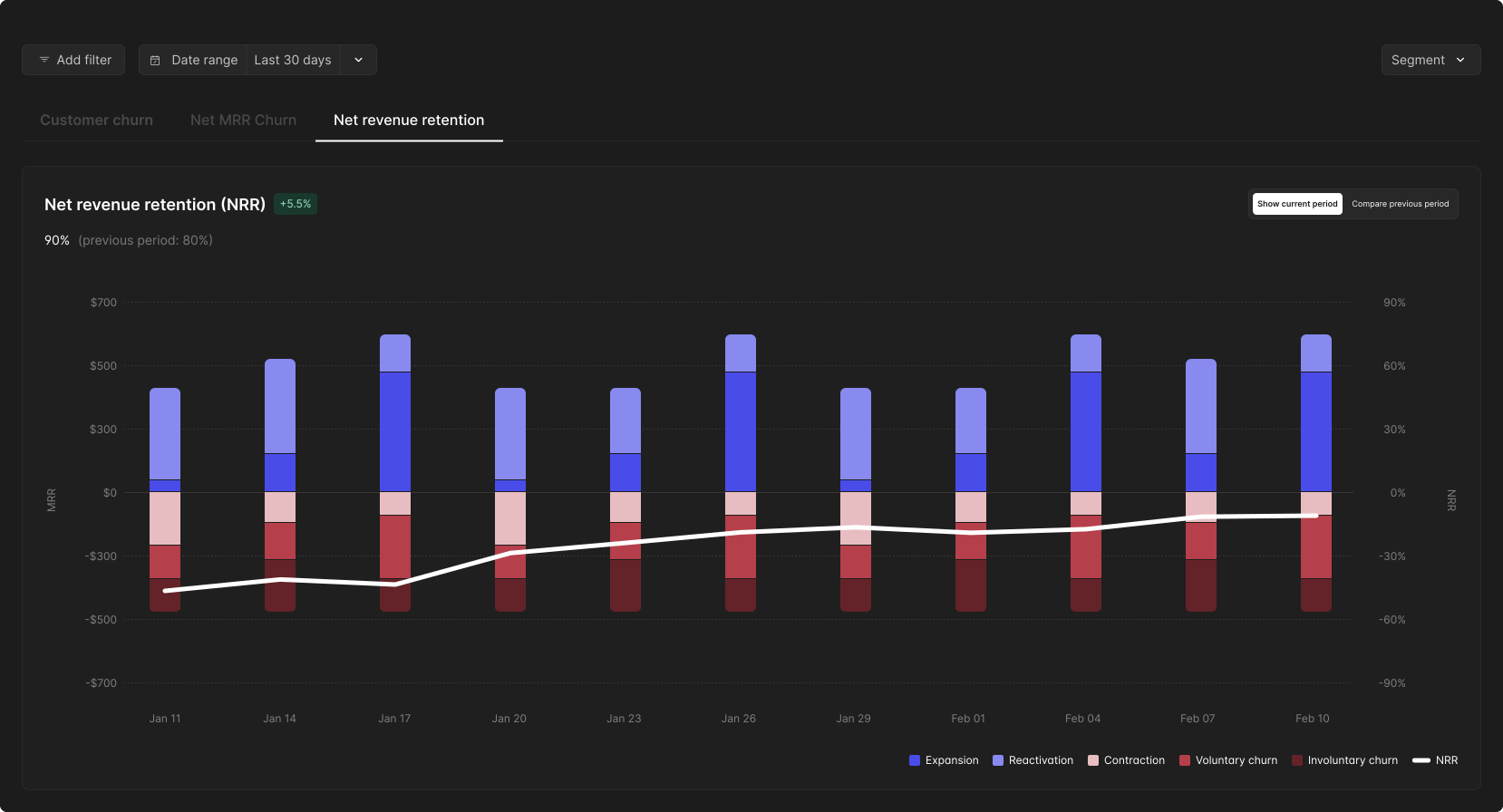
Of everything you attempted to charge,how much got through — tracked over time so a change in fraud rules or routing shows up as a visible step in the line, not an anecdote.
The same question in dollars. Attempted volume against successful volume tells you what declines actually cost last month,which is the number that gets an optimization project funded.
Every processor’s authorization rate in one table, split by card type and region. This is where underperformance stops hiding —and the evidence you bring to your next rate negotiation.
Both use percentage-of-revenue models at scale, so the marginal rate matters more than the sticker price — model it at next year’s revenue,not today’s.
PRICING
Single-processor setup
One pipe, one risk appetite, one ceiling.
With authorization optimization
Multiple processors, one intelligent layer on top.
Best fit
Recurring charges hit the same optimization surface every cycle, so every point of improvement repeats monthly. This is also where network tokenization earns its keep — card churn is constant at volume, and tokens absorb most of it silently.
High-volume subscription businesses with recurring billing
Cross-border is where single-processor setups leak the most. Local acquiring through the right processor per region routinely beats one global pipe on both approval rates and fees — routing by geography is often the single biggest lever available.
Teams processing across multiple geographies
If you’ve already tuned retries and fraud rules and the number won’t move, you’re at the structural limit. Adding a second processor and routing between them is what moves it — teams in this position tend to see the fastest, clearest lift.
Businesses that have hit a ceiling on a single PSP
FAQ
Billing that matches Recurly and Chargebee feature for feature— plus the processor layer neither of them owns. Run it against your own numbers.